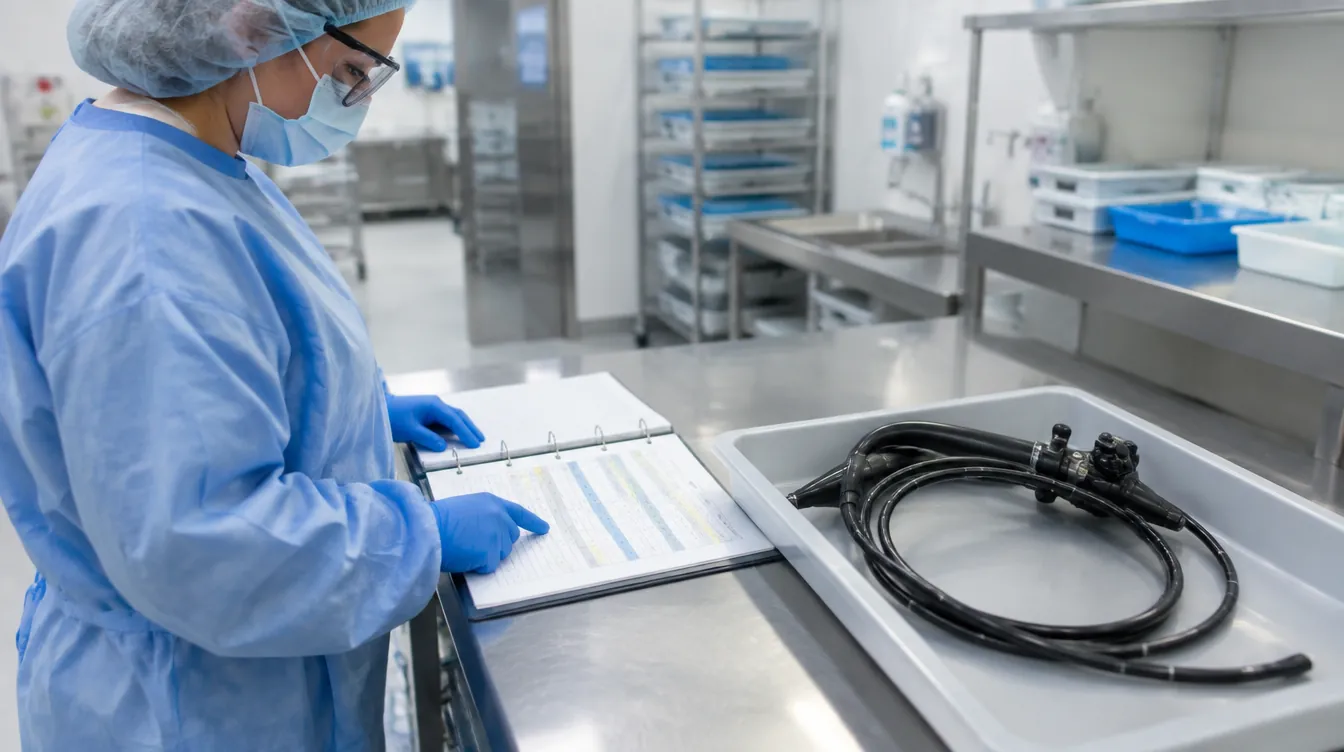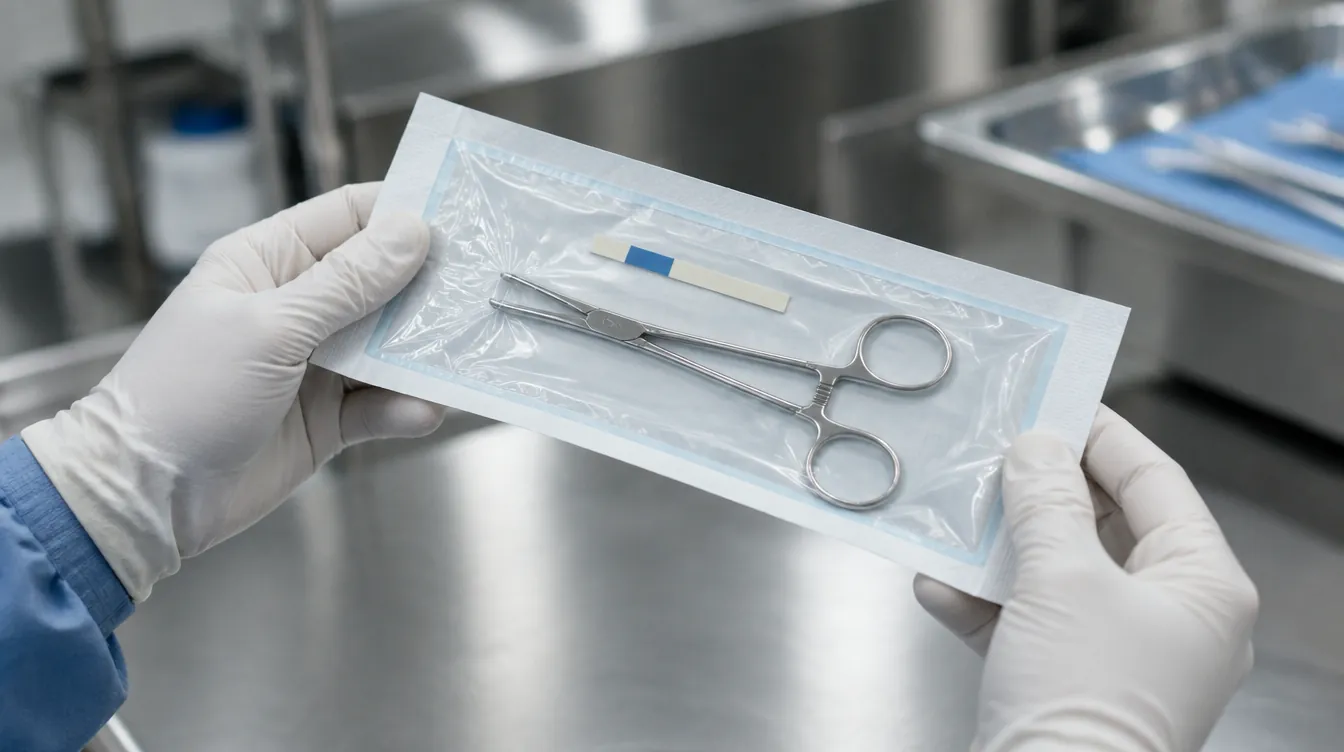
High-level disinfection and sterilization have different purposes. Understanding the difference helps sterile processing students and working technicians ask better questions about a device, its intended use, and the process required before it can return to patient care.
The shortest explanation is this: high-level disinfection is not the same as sterilization. The correct process depends on the device and how it will be used, together with its validated instructions. You cannot choose a process simply because it is available or familiar.
This guide explains the concepts and offers a way to study them. It is not a processing recipe for a particular endoscope, instrument, disinfectant, or machine.
Start with what the device will contact
The CDC describes three categories in the Spaulding classification. Critical devices enter normally sterile tissue or the vascular system and require sterilization. Semicritical devices contact mucous membranes or nonintact skin and require at least high-level disinfection. Noncritical items generally contact intact skin and need the appropriate lower level of disinfection. High-level disinfection does not reliably eliminate large numbers of bacterial spores; sterilization addresses all forms of microbial life. CDC: A Rational Approach to Disinfection and Sterilization.
| Category | General contact | General processing expectation |
|---|---|---|
| Critical | Normally sterile tissue or vascular system | Sterilization |
| Semicritical | Mucous membranes or nonintact skin | At least high-level disinfection |
| Noncritical | Intact skin | Appropriate low-level disinfection |
This table is a starting point for understanding risk. It does not replace the device's instructions or resolve unusual clinical uses. When the use or classification is unclear, the team responsible for the device must clarify it before selecting a process.
Why the word “endoscope” does not answer the question
An equipment category can contain devices with different designs and uses. A familiar name does not establish everything you need to know about a particular model or accessory.
For learning purposes, ask three separate questions: What is this device? What will it contact? Which instructions apply to this exact item? Keeping those questions separate prevents you from assuming that every item used during the same procedure has the same processing requirement.
An accessory deserves its own attention. Do not let its small size or its association with a larger device make it invisible in the discussion. The person preparing the item needs access to the information that applies to it.
If you are new to the field, begin with what sterile processing is, then return to this comparison. The concepts are easier to understand when you can picture the full journey of reusable equipment.
Cleaning is a separate job
Cleaning removes soil; disinfection and sterilization address microorganisms through validated processes. The CDC identifies thorough cleaning as a necessary step before either high-level disinfection or sterilization. Residual organic and inorganic material can interfere with subsequent processing. CDC: Cleaning.
For a learner, the practical implication is to ask what evidence belongs to each stage. A record showing that a later stage occurred does not, by itself, explain what happened earlier. Your study notes should preserve those distinctions.
Try writing three short definitions on separate cards: cleaning, high-level disinfection, and sterilization. Under each definition, add the question that stage is intended to answer. If your explanation of one stage depends entirely on another, return to your reference and clarify the boundary.
A completed machine cycle is only one part of the story
Imagine reviewing a hypothetical processing record. You see a completed cycle, but the device identity is unclear. Would that record help you confirm that the correct instructions and equipment combination were used?
This is an information problem before it becomes a machine problem. In a learning discussion, identify which facts you would need, where they should be recorded, and who can resolve the gap.
Avoid turning a machine's completion message into a universal claim about a device. Ask what the machine actually monitors and what responsibilities remain outside it. Your department's approved process should define how records, observations, and release decisions fit together.
That habit is useful in both instrument processing and endoscope reprocessing. It encourages you to understand the meaning of a result instead of memorizing where a green light appears.
What instructions need to agree?
A processing system can involve a reusable device, cleaning products, accessories, an automated reprocessor or sterilizer, and other equipment. Instructions need to support the actual combination being used.
FDA explains that reusable devices need specific reprocessing methods and that complexity, training, equipment, and communication can affect performance. FDA: Factors Affecting Quality of Reprocessing.
When studying a workflow, make an information map rather than inventing a combined procedure. List the relevant instructions and identify the person responsible for resolving an apparent mismatch. A map helps you see missing information; it does not authorize a workaround.
For example, “the product is available in our department” and “the product is appropriate for this exact device and process” are different statements. Ask what documentation connects them.
Five useful questions for a training discussion
1. What establishes the required process?
Ask the educator to show how intended use, device identification, current instructions, and approved policy are considered together. You are learning how a decision is made, not just learning its conclusion.
2. Where does the current instruction live?
Knowing that a document exists is different from being able to retrieve it during a shift. Ask how your facility identifies the current version and handles an unavailable or unclear document.
3. Which parts require a person to verify information?
Use the actual workflow to identify where the operator must confirm something that equipment does not decide independently. Ask how that verification is taught and documented.
4. What happens when a requirement is not met?
An explanation of the normal process is incomplete without a response to an exception. Ask who is contacted, how the item is identified, and how its status is communicated under local policy.
5. Who makes the release decision?
Ask which role has authority and what evidence that role reviews. Students should learn the decision boundary early rather than assuming that the person closest to the equipment is always the decision-maker.
Why “more” does not automatically mean “better”
It can feel reassuring to extend an exposure, repeat a cycle, or add a chemical step. But a personal adjustment is not the same as a validated method. The useful question is whether the complete process matches the applicable instructions.
The 2025 multisociety guidance on sterilization and high-level disinfection addresses manufacturer instructions, processing methods, monitoring, and implementation. Its broad scope reinforces the need to examine the whole system rather than treating one exposure step as the entire program.
In a class discussion, explore the assumptions behind an improvised adjustment. What problem is someone trying to solve? What information is missing? Who has the authority and expertise to evaluate the proposed change? Those questions move the conversation toward a defensible decision.
Read industry headlines without turning them into policy
You may encounter articles about new sterilization technologies, additional endoscope processing measures, or different storage practices. Reading them is worthwhile. Applying them requires a different level of review.
A headline rarely tells you all the conditions: the device models, the study design, the number of observations, the facility's equipment, or the limitations. An article about one method is not evidence that every department should replace its current process tomorrow.
When you bring an article to an educator, attach a question. “Does this apply to any device we use?” is more useful than “We should do this now.” Ask what primary source sits behind the report and whether current instructions support the proposed use.
This approach lets you stay curious without confusing professional reading with an approved procedural change.
A study exercise: classify the question before answering it
The following hypothetical prompts are designed for discussion, not as actual examination questions.
Prompt one: Someone asks whether a device should receive high-level disinfection or sterilization, but has not identified its model or use. Your first task is to recognize that the question lacks essential information.
Prompt two: A colleague says a device is ready because its machine record shows completion. Your task is to explain which other parts of the facility's release process need to be understood before drawing a conclusion.
Prompt three: An accessory is described as “the same kind we usually use.” Your task is to identify how its exact identity and applicable instructions would be confirmed.
Prompt four: A product is marketed as compatible with many devices. Your task is to find the evidence for the specific combination under discussion, rather than treating the broad description as sufficient.
For each prompt, write the missing fact, the source you would consult, and the person you would ask. The exercise strengthens your ability to recognize uncertainty, which matters as much as remembering definitions.
Create a comparison sheet that remains useful
A good comparison sheet leaves room for details that vary. Do not fill every blank with a universal answer just to make the page look complete.
Use headings such as intended use, applicable instructions, prerequisites, equipment, required records, and escalation contact. Mark device-specific fields clearly so a learner does not mistake the sheet for a ready-to-use procedure.
Keep the sheet in the classroom or approved training system. If it will be used at a workstation, it needs the same local review and document control expected of other job aids.
The best learning tool makes the authoritative source easier to find. It should not become an unofficial replacement that slowly drifts away from the original instructions.
What supervisors should listen for
During teach-back, listen for how a technician connects concepts. Can the person explain why device use matters? Can they distinguish cleaning from later processing? Do they know when they need more information?
A confident answer is not enough if it relies on a broad assumption. Ask a follow-up question that changes one condition, such as a different accessory or an unfamiliar model. The goal is to reveal the reasoning, then coach any gap.
Avoid rewarding people for guessing quickly. Make it acceptable to say, “I need to check the instructions for that item.” The ability to recognize the limit of one's knowledge is an important part of professional practice.
For a broader look at how education connects to performance, see why hands-on sterile processing training matters.
Use accurate language outside the department
Students may explain their work to family members, classmates, or colleagues from another service. Practice a short description that preserves the difference between cleaning, disinfection, and sterilization without overwhelming the listener.
For example, explain that reusable devices move through a defined process based on their use and instructions, and that different stages have different purposes. Avoid calling every processed item sterile just to simplify the conversation.
If someone asks about a particular patient's care or a device you do not know, refer the question to the appropriate clinical team. Clear general education is useful; a confident answer about an unfamiliar case can create a misunderstanding.
Frequently asked questions
Does high-level disinfection make an item sterile?
No. Use the terms accurately in conversation and documentation. A high-level disinfected item should not be described as sterile simply because it has completed its required process.
Can an automated endoscope reprocessor decide the right process for me?
Learn the specific system's capabilities and your facility's responsibilities. Device compatibility, required preparation, connections, records, and release criteria cannot be replaced by a general assumption about automation.
Is sterilization appropriate for every reusable device?
The method must be validated for the device and its intended use. Material compatibility and the manufacturer's instructions matter. Escalate a mismatch rather than improvising a method.
Should I memorize one disinfectant exposure time?
Learn why time, conditions, and compatibility matter, then use the actual product and equipment instructions. A number from an online article is not a universal operating instruction.
Is this distinction relevant to CER preparation?
Yes. Understanding terminology gives you a foundation for studying the larger endoscope workflow. Pair definitions with explanations and supervised discussion rather than memorizing isolated facts.
Keep building the foundation
The most useful next step is to take one device from a supervised training discussion and trace how its required process is established. Focus on the sources and reasoning, not on copying a procedure from memory.
To hear about ATS's upcoming endoscope exam-preparation option, join the free CER class waitlist. Pricing, dates, and format have not yet been announced. ATS is an independent training provider and is not affiliated with HSPA.