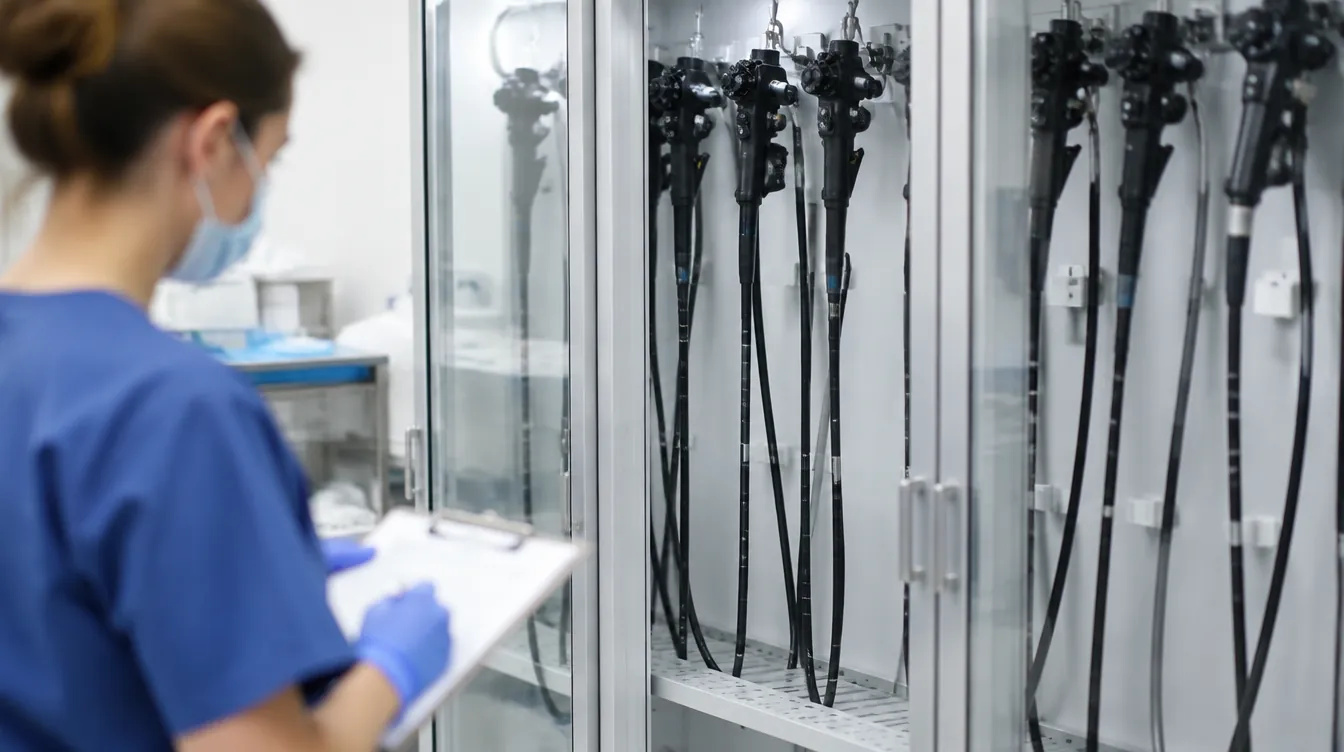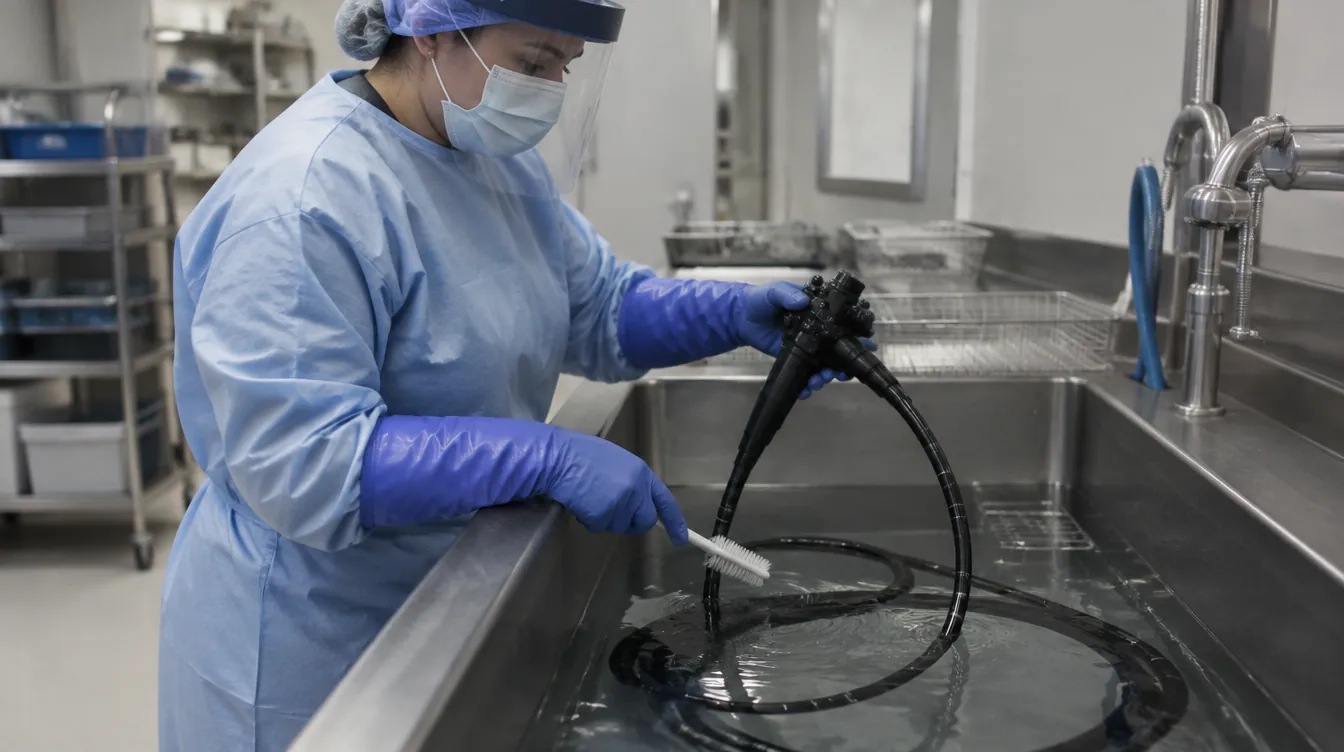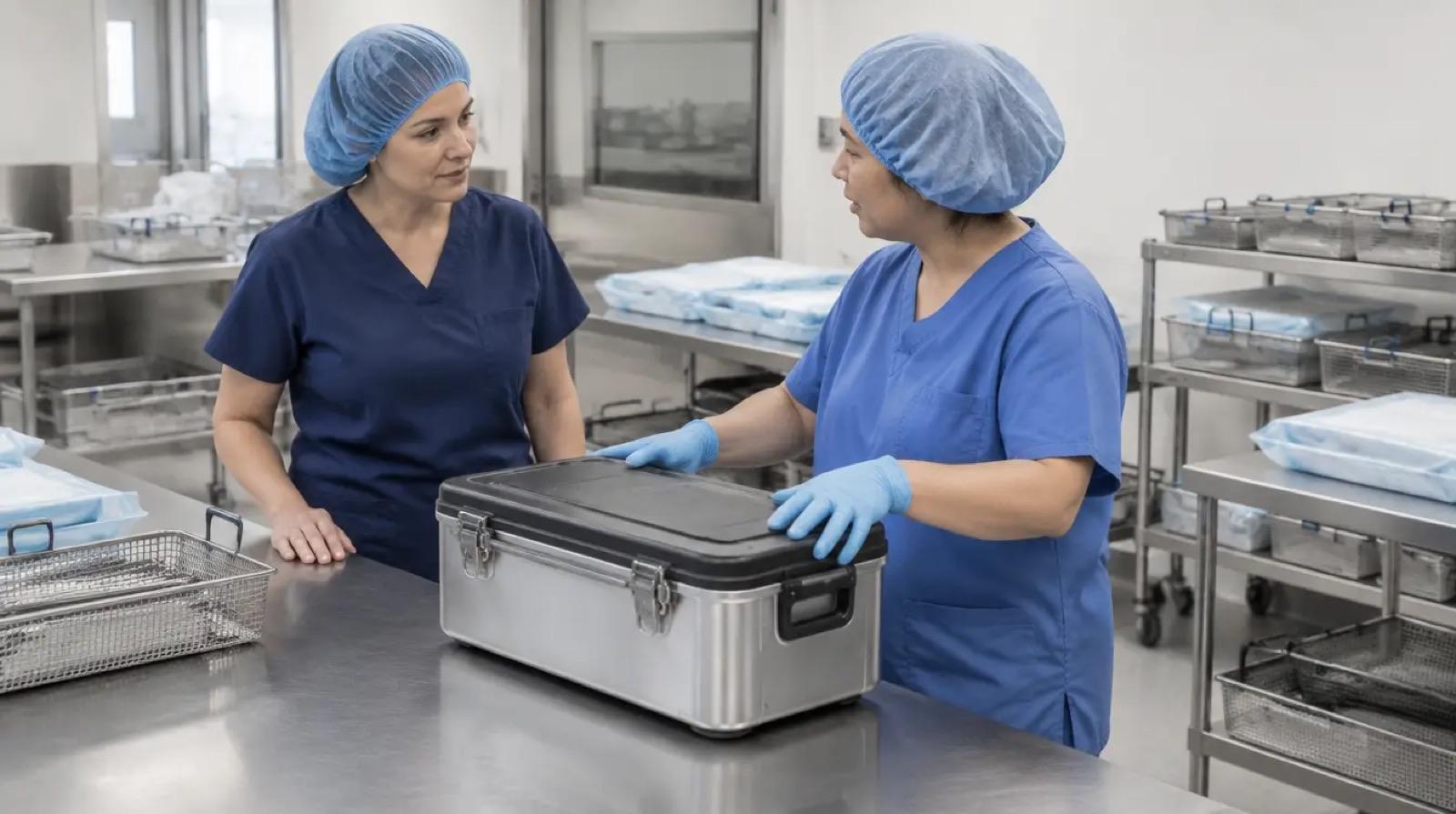
An endoscope reaches the receiving area in a covered container. The person delivering it says it came from another room. Before anyone acts on that handoff, the receiving team needs to know which device it is, what its current processing status means, and who can resolve missing information.
A lid helps contain or protect an item as intended by the approved transport system. It does not, by itself, tell you whether the endoscope is used, awaiting processing, or ready for patient use. That distinction belongs in the facility's transport process, documentation, and staff training.
This guide offers questions and original learning exercises for reviewing endoscope transport within a healthcare facility. It does not prescribe a universal container, processing delay, or release procedure. Use the current instructions for the endoscope and transport system, along with the facility's approved policy, for the actual task.
Treat transport as a defined part of the program
CDC/HICPAC's essential-elements guidance includes transport in the policies needed for an endoscope reprocessing program. It also calls for device identification and traceability, and for recording procedure-end and manual-cleaning start times so that staff can assess processing delays against manufacturer instructions. CDC/HICPAC: Essential Elements of a Reprocessing Program for Flexible Endoscopes.
A practical application is to review the movement between work areas as its own task. A technician may understand cleaning thoroughly and still have unanswered questions about where to receive a device from another unit. A transporter may understand the route without knowing how to handle an uncertain status.
Bring the people who send, move, receive, and document the devices into the review. Ask them to describe what happens on an ordinary shift and when the normal receiver is unavailable. Differences between those descriptions help identify the questions a local procedure needs to resolve.
Begin with three separate questions
The first question is identity: which endoscope is moving? The second is status: what work has actually been completed and documented? The third is destination: where should this item go next under the approved process?
Those questions are related, but they are not interchangeable. Knowing a room of origin does not establish a device identifier. Knowing the identifier does not establish that processing is complete. Knowing the usual destination does not establish that it is appropriate for the item's current status.
Teach learners to explain each answer separately. If they say “it is the usual scope,” ask what record or identifier confirms that. If they say “it is clean,” ask what that word means in the facility's approved status system.
Use the terms required locally, with their defined meanings. Informal phrases can conceal important differences between precleaned, cleaned, high-level disinfected, sterilized where applicable, and released for use. A shared vocabulary should make those distinctions easier to recognize.
Review the container for the intended journey
Choose and use the transport system through the facility's approved process and applicable manufacturer instructions. The questions include whether the system is appropriate for the device, its processing status, the route, and the handling needed at both ends.
Do not assume that a case supplied for shipping an endoscope has the same purpose as a facility transport container. CDC specifically cautions against using an external carrying case for routine transport or storage within the healthcare environment. CDC: Disinfection and Sterilization Recommendations.
For a local review, ask staff to show where the transport-system instructions are kept and how they select the correct supplies. Include lids, liners, supports, or other components only as specified for the approved system. A substitute that looks similar may leave compatibility or handling questions unanswered.
Keep the evaluation specific. “We have plenty of bins” says little about whether the intended system is available where a particular device starts its journey. Review the actual starting point, not only the central supply location.
Make status recognizable without relying on memory
Review how the facility distinguishes used devices from those that have completed their required process. CDC recommends protocols that allow users to identify an endoscope that has been properly processed and is ready for use. The particular labels and verification steps need to be defined in the facility's system.
A local color convention can help staff navigate that system, but color should not become an unsupported assumption about clinical readiness. Ask what happens when a label is missing, an electronic record disagrees, or a container arrives from a unit using different terminology.
The learning goal is to recognize the mismatch and use the approved escalation process. A receiver should not have to guess what a sender meant. An educator can test this with a fictional record, without placing an uncertain clinical device into a training exercise.
Include the source of the status information in the discussion. Staff should be able to find the relevant record and explain who is authorized to resolve an inconsistency. Repeating a color code from memory is a narrower skill.
A transport review worksheet
The table below is an original discussion tool for a facility team. It is not a complete transport checklist or a replacement for the approved procedure. Use it to find unanswered questions before creating or revising a local job aid.
| Review point | What the team should be able to explain | Example of a gap to investigate |
|---|---|---|
| Device identity | How the device is matched to its record | Staff recognize the model but cannot confirm the individual item |
| Processing status | What evidence establishes the current status | A verbal description conflicts with the approved record |
| Transport system | Which approved system applies to this journey | Required supplies are absent at an off-hours location |
| Timing information | Where required timestamps are recorded | The receiver cannot locate the procedure-end information |
| Destination | Where the item is received for its current status | The usual receiving area is closed |
| Transfer of responsibility | Who accepts the handoff and follows up | A delivery is left without an identified receiver |
| Exception process | What staff do when information is uncertain | Nobody knows who answers after hours |
Have staff explain the current process before proposing a fix. A missing field, inaccessible record, and unclear responsibility can look like the same handoff failure. They require different corrections.
Protect the time record without inventing a deadline
A transport review should examine whether required timing information stays accessible to the reprocessing team. Do not reconstruct a timestamp from memory just to complete a field. If information is missing, document the uncertainty and follow the approved response.
The applicable endoscope instructions and facility procedure determine how a processing delay is assessed and managed. This article does not supply a universal number of minutes or a generic delayed-processing recipe. A transport team's estimate should not silently become a clinical parameter.
For an educational exercise, give learners a fictional handoff with one missing time field. Ask where they would look, whom they would contact, and which approved instructions would govern the unresolved situation. Assess the reasoning and escalation, rather than rewarding a guessed time.
If the same field is frequently missing, investigate how it is captured at the source. Adding another reminder at receiving may not help if the original documentation step is difficult to access or its owner is unclear.
Walk the actual route with the right people
A route review can be conducted as an observation or simulation that does not interfere with clinical work. Include the starting area, doors, transfer points, receiving area, and return of reusable transport equipment. Ask where staff pause and why.
Look for a mismatch between the written process and the physical environment. For example, the intended receiver may be on a different floor after hours. Supplies may be stored behind a locked door that the assigned transporter cannot access. Record the specific obstacle rather than calling the entire route unsafe without evidence.
Evaluate clean and contaminated movements through the facility's infection-prevention process. Personal protective equipment, hand hygiene, containment, and handling practices need to match the task and approved instructions. A route sketch cannot determine those requirements on its own.
FDA identifies staff responsibilities, available equipment, training, and access to device instructions as factors affecting reprocessing quality. Those are useful categories for organizing questions that surface during the walk-through. FDA: Factors Affecting Quality of Reprocessing.
Plan for the receiver who is not available
A normal-shift procedure can appear clear because the same colleagues work together every day. Test the situation in which the usual person is absent. Who receives the device, where is it placed under policy, and who is told about unresolved information?
Avoid relying on an informal agreement that only two employees know. Put the authorized backup arrangement into the appropriate local document and teach it to everyone with a role in the transfer. Include the people who cover breaks, weekends, and unusual procedure locations.
A useful training prompt is: “The destination is correct, but nobody is there to accept the handoff. Show where you find the next step.” The learner should retrieve the approved instruction or contact the assigned person, rather than inventing a drop-off location.
When reviewing the process, separate urgency from authority. A busy schedule explains why staff need a workable backup plan. It does not establish permission to label an uncertain device ready or omit required information.
Hypothetical example: the container arrives with conflicting status
Imagine that a covered container reaches a receiving station. Its external status cue suggests one category, but the accompanying record suggests another. The delivering employee cannot explain the difference. This is a fictional teaching scenario, not a report of an ATS facility or patient event.
The first learning objective is recognizing that the discrepancy needs resolution under the approved process. The second is communicating the facts: the device identifier, the two conflicting pieces of information, the location, and the person contacted.
Do not teach the scenario by asking learners to choose whichever status seems more likely. Ask how the item is controlled while the authorized team resolves the uncertainty and how the final decision is recorded. The specific disposition belongs to that team's procedure and technical sources.
After the immediate issue is resolved, examine how the conflicting information was created. Was an old label retained? Was the wrong record attached? Did the sender and receiver use different definitions? Each possibility calls for investigation before a correction is selected.
Include reusable transport equipment in the workflow
If transport equipment is reusable, the local process needs to explain its own cleaning, disinfection where applicable, inspection, and return to availability according to its instructions. Do not assume that an empty container is ready for another journey.
For the review, ask who performs that work and how the next user recognizes availability. Identify where used transport equipment waits, where the approved work occurs, and who replenishes required supplies. Keep these arrangements consistent with the facility's separation of clean and contaminated activities.
The administrative failure to watch for is an unassigned step. The sender may believe the receiver resets the system, while the receiver believes that another service does it. Ask each group independently before concluding that the task has an owner.
If a liner or accessory is disposable, follow its labeling and local disposal procedure. Do not create an improvised reuse method to compensate for a supply shortage. Report the shortage so that the authorized team can determine the response.
Practice with scenarios that reveal understanding
Use mock records and approved training equipment to teach exceptions. One scenario can omit an identifier; another can place the correct device at an unexpected receiving location. A third can make required documentation temporarily inaccessible.
Ask learners to explain what they know, what remains unknown, and what their role authorizes them to do next. This approach makes it easier to see whether they understand the purpose of the process or have memorized only the ordinary sequence.
Do not deliberately compromise a patient-care item to make the exercise realistic. Keep the simulation clearly separate from available clinical inventory. If the exercise reveals a gap in policy, stop treating it as a learner error and route the gap for review.
Provide feedback tied to the actual task. A learner who identifies the problem but cannot find the contact pathway needs different support from someone who does not recognize the status mismatch. Repeating the entire orientation may obscure that distinction.
Audit a small sample and close one gap
Select a manageable sample of transfers using your facility's approved quality process. Define what you are checking before collecting observations: identity match, accessible documentation, correct destination, or completion of the required handoff. Keep patient information in authorized systems.
Record what was observed and what evidence was unavailable. Avoid turning a small sample into a claim about every transfer in the department. If different reviewers interpret the same status cue differently, clarify the definition before comparing results.
Choose one improvement with a named owner. It might be clarifying the after-hours receiver or moving approved supplies to the location where they are needed. Review whether that specific problem becomes easier to resolve after the change.
For the broader education context, read why hands-on sterile processing training matters. Transport competence includes explaining and demonstrating the approved response to uncertainty, not simply carrying a container to a familiar door.
Frequently asked questions
Does a covered container prove that an endoscope is ready for use?
No. The container does not establish processing status by itself. Use the facility's approved identification, documentation, and release process to determine whether the device is ready for its intended next step.
Can a shipping case be used for routine transport inside the facility?
Do not assume it can. CDC cautions against using an external carrying case for routine in-facility transport or storage. Use the approved transport system and its applicable instructions.
What if the processing status or a required timestamp is unclear?
Follow the facility's exception process, preserve the known facts, and contact the authorized person to resolve the uncertainty. Do not invent a time or change a status based on an assumption.
Is there one maximum transport time for every flexible endoscope?
This article provides no universal transport interval. Use the instructions for the specific endoscope and the facility's approved process to assess delays and determine any required response.
Should transport training include staff who do not clean endoscopes?
Include everyone assigned a role in sending, moving, receiving, or documenting the devices. Training should address each person's actual responsibilities and the approved way to handle an exception.
Turn the review into a focused learning question
Start by asking a trainer to walk through one approved transport route and one exception. Identify the device, explain its status, and locate the source that directs the next step. If you are interested in further endoscope education, join the free ATS CER class waitlist. The waitlist is for updates about the planned class; it does not establish certification eligibility or replace device-specific workplace training.