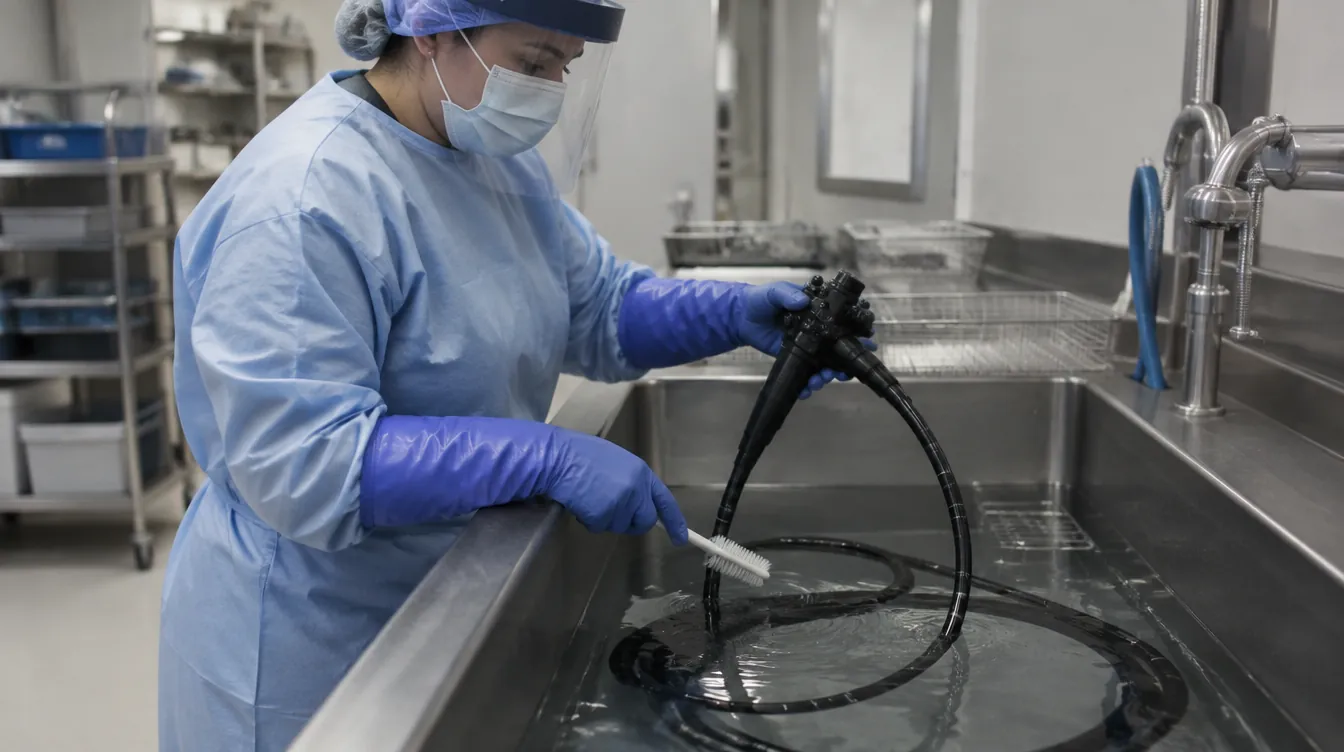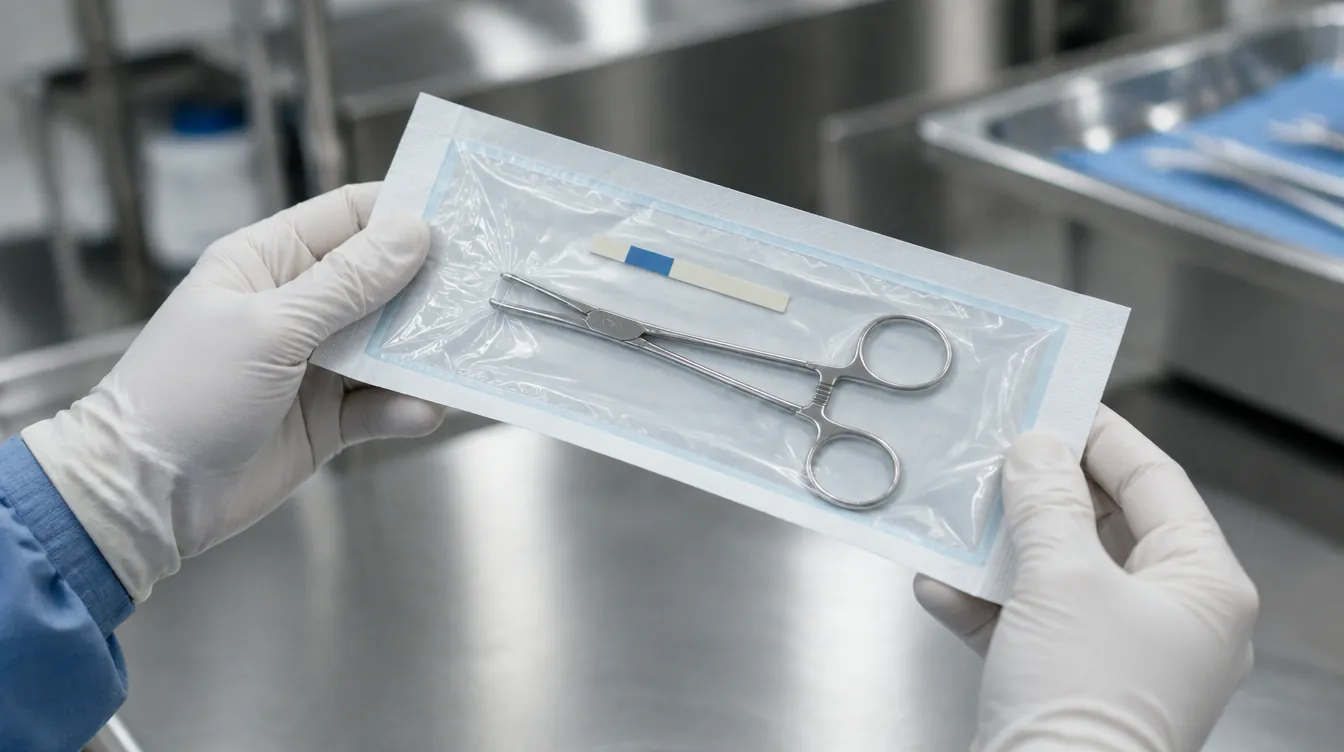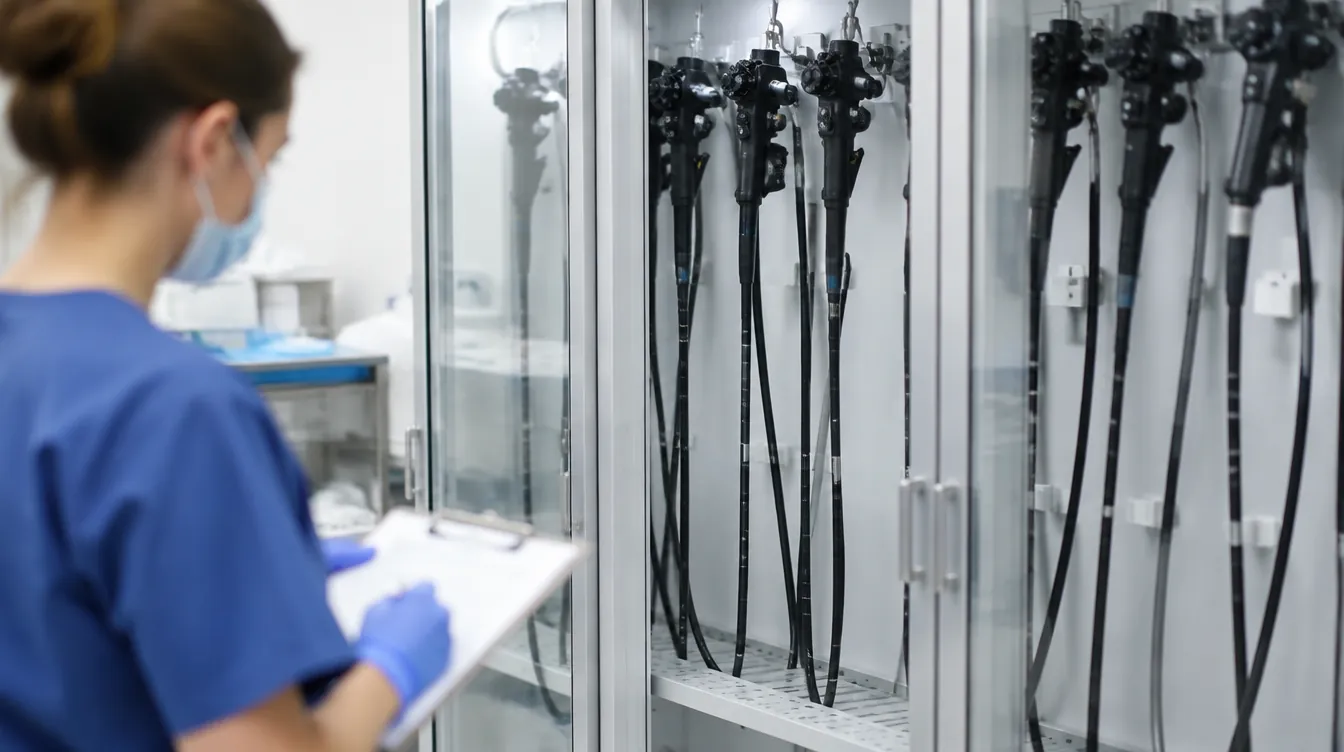
Endoscope drying and storage deserve the same attention as the processing stages that come before them. A conversation that ends when high-level disinfection finishes leaves important questions unanswered: how the device is dried, how its status remains clear, and how it is protected while waiting for use.
For endoscope reprocessing students, these topics connect technical knowledge with everyday decisions. For supervisors, they connect equipment capacity, documentation, and staff responsibilities.
This guide explains the questions to ask. Use current device and equipment instructions and your facility's approved policy for the actual drying method, storage conditions, and response to any concern.
What does “hang time” mean?
In endoscope discussions, hang time commonly refers to the interval a processed endoscope remains in storage before another processing cycle is required by the facility's policy. The phrase can be misleading if it makes the issue sound like a simple countdown.
Storage time is only one part of the question. A policy also needs to account for the device, its processing history, drying, storage system, handling, and the information used to establish readiness for use.
Do not treat the age of a storage label as the only fact that matters. A device with an unclear status needs a response under the facility's procedure even if a date appears to be within the permitted interval.
Is there one universal endoscope hang time?
The 2021 multisociety guideline on flexible GI endoscope reprocessing found insufficient data to set one maximum storage duration for appropriately reprocessed, dried, and stored flexible endoscopes. It advises units to assess the evidence and risks when developing their policy. It also emphasizes drying after reprocessing and following manufacturer instructions for drying and storage.
That means a number from another facility should be treated as information to evaluate, not permission to change your own policy. A local decision needs the responsible clinical, infection prevention, and processing teams to review the circumstances.
If you are a technician, the practical question is straightforward: where is the current approved policy, and who resolves uncertainty about a particular device?
What recent AAMI coverage actually tells us
In February 2026, AAMI discussed a facility's transition to a 14-day endoscope hang time. The report describes a local risk assessment, committee approval, and monitoring around the change. It is an example of a decision process at that facility, not a universal 14-day recommendation.
The transferable lesson is how to examine a proposed change. Identify the reason for it, gather relevant evidence, evaluate your own conditions, obtain the appropriate approval, and define how the result will be reviewed.
A headline can make the outcome sound like the main lesson. For a leader, the reasoning and controls behind that outcome are more useful. Without them, another organization's result is difficult to interpret.
Distinguish a drying question from a storage question
A drying question asks how the required drying process is completed for a particular device and system. A storage question asks how the processed device is held and protected until use. The answers are connected, but they are not interchangeable.
In a training discussion, ask the learner to describe each responsibility separately. Who confirms the required drying activities? Who records status? Who handles the device afterward? Who responds if storage conditions or identification are uncertain?
If every answer is “the cabinet,” the discussion needs more detail. The equipment's validated capabilities should be understood, and the responsibilities of the people using it should be clear.
An educator can use the actual instructions to explain where one stage ends and another begins. A generic article cannot make that determination for every cabinet and scope combination.
Map the path after reprocessing
Draw the device's route from the end of its processing sequence to storage and then to the procedure area. Keep the drawing simple enough that staff from different shifts can recognize it.
At each transition, ask three questions:
- What information travels with the device?
- Who is responsible for its status at this point?
- What would make that person pause and escalate a concern?
The exercise can reveal an unclear handoff even when each team understands its own work. For example, storage staff may expect one record while the receiving area uses another description of readiness.
Use the map to clarify the approved process. Do not add informal labels or new release criteria without the review required by your facility.
A storage walkthrough that produces useful findings
A walkthrough should answer a question, not simply confirm that a room looks orderly. Choose a narrow focus, such as how staff distinguish device status or how they locate the current storage policy.
Ask staff to demonstrate the information flow using an appropriate training example. Avoid exposing patient information during a general education session.
Record what you observed and what remains unknown. “Unable to locate the policy at this workstation” is actionable. “Staff need more education” is too broad unless you identify the exact knowledge or performance gap.
Then assign the right owner. A document-access problem may need a system correction. An equipment question may need a manufacturer response. A role ambiguity may need agreement between departments.
Questions to ask about a storage system
The following table is an original planning aid for educators and leaders. It is not a technical specification or an inspection standard.
| Topic | Useful question | Who may need to help |
|---|---|---|
| Device fit | Which devices and configurations does the system support? | Manufacturer, educator, processing leadership |
| Instructions | Can staff retrieve the current operating information? | Document owner, educator |
| Capacity | Does the actual workload fit the approved workflow? | Processing and procedural leadership |
| Status | How is readiness or an unresolved concern communicated? | Staff using the tracking process |
| Maintenance | Who owns scheduled service and responses to faults? | Equipment owner, service team |
| Policy changes | How do updates reach all affected shifts? | Policy owner, educator |
Use the answers to build a local review plan. Do not substitute this list for the manufacturer's instructions or the facility's existing requirements.
Avoid buying equipment before defining the problem
If storage is causing recurring difficulty, identify the problem precisely before deciding what to buy. Is the issue capacity, an unclear status record, unsuitable placement, an equipment fault, or staff access to instructions?
Different problems need different responses. A new cabinet will not automatically resolve unclear ownership of a record. A clearer label will not resolve an equipment limitation. A training session will not create physical capacity that the department does not have.
Write a short problem statement using an observation rather than a conclusion. For example: “During the afternoon handoff, staff cannot identify who is responsible for resolving a storage-status question.” That statement points toward a workflow review.
Include the people who use the equipment in any evaluation. They can explain where work slows down, which instructions are difficult to access, and what questions arise during routine shifts.
A hypothetical scenario: the label looks current, but the history is unclear
Imagine a staff member finds a scope with a storage label that appears current. The available record does not clearly establish the device's status after an earlier interruption.
The learning question is whether the label alone answers the concern. It does not resolve missing history. Staff should use the approved process for identifying the concern, preventing uncertain release, and involving the responsible person.
After the immediate issue is addressed, examine how the uncertainty arose. Did a handoff omit information? Was an equipment interruption documented somewhere else? Did the tracking system allow two different descriptions of the same status?
The follow-up should repair that gap. Telling staff to read labels more carefully would not address a record that lacks necessary information.
This is an illustrative scenario, not a report of an ATS client event or a substitute for a facility's release policy.
How to discuss a proposed hang-time change
A useful proposal begins with the reason for considering a change. Avoid starting with a preferred number and looking only for articles that support it.
Describe the current problem and the devices affected. Identify the applicable instructions, current policy, professional guidance, equipment conditions, and local data the responsible team needs to review.
Make uncertainty visible. If the evidence comes from another setting, explain what you do not know about how that setting compares with yours. If an instruction is unclear, obtain clarification before presenting the proposal as settled.
The team should also define who can approve the change, how staff will be trained, what documentation will change, and how concerns will be monitored afterward. These are implementation questions, and they deserve attention before the effective date.
Until that process is complete, the approved current policy remains the staff's reference.
Build a training session around decisions
A presentation about storage can become a list of facts that staff already recognize. Make the session more useful by including questions about uncertainty and handoffs.
Ask learners to locate the policy, interpret a training record, identify the responsible contact, and explain what they would do with an unresolved status question. Use fictional records rather than patient information.
Then ask them to describe what happens after they raise the concern. Who acknowledges it? Who decides the next action? How will the next shift know whether it has been resolved?
This approach teaches the process around the equipment. It also gives the educator a chance to spot differences between shifts before those differences become routine workarounds.
For more on connecting education with practice, see hands-on training in sterile processing.
What to document when reviewing the workflow
Keep review records factual and limited to the purpose of the review. Record the date, the scope of the observation, the issue found, the responsible owner, and the agreed follow-up.
Avoid making a broad claim such as “storage is safe” from a brief walkthrough. Say what was examined and what was not. A review of document access does not establish equipment performance or patient outcomes.
If the issue is recurring, track whether the corrective action was completed and whether the same problem appears again. Closing a task in a spreadsheet is different from showing that the underlying obstacle has been removed.
Share the result with staff who identified the concern. Knowing that a question produced a useful correction gives people a reason to keep reporting problems early.
Prepare for equipment downtime before it happens
Ask the responsible team where the approved downtime plan lives and which roles activate it. Staff should know how an equipment fault changes assignments, who communicates availability to the procedure area, and how unresolved device status is managed.
Do not create an alternative drying or storage method during a tabletop exercise. Use the exercise to identify missing decisions and send them to the people qualified to resolve them.
Include the return to service in the discussion. Who confirms the equipment can be used again? How do staff learn that the interruption has ended? How are outstanding records reconciled? A complete plan addresses both the disruption and the transition back to normal work.
Frequently asked questions
Is 14 days the new rule for every endoscope?
No. The AAMI report describes a facility's evaluated change. Use your own approved policy, current instructions, and the responsible team's review process.
Does a storage cabinet automatically complete drying?
That depends on the system's validated design and instructions. Ask the educator or manufacturer to explain what the specific equipment does and what operator tasks remain required.
Can a storage date settle an unclear device status?
A date cannot resolve every concern about processing history, handling, or storage. Follow the facility's procedure for uncertain status and escalation.
Should students memorize a single hang time?
Learn how storage policy is established and where to find the applicable requirements. Recognizing when a number is device- or facility-specific is more useful than treating it as universal.
What is the best first improvement?
Choose one observed gap, such as unclear ownership or difficult document access. Resolve it with the appropriate team and check the result before expanding the project.
Make drying and storage part of your learning plan
These topics connect the science of reprocessing with documentation, communication, and everyday judgment. Give them dedicated study time rather than treating them as the last slide in a presentation.
For updates on ATS's upcoming endoscope exam-preparation class, join the free CER waitlist. Pricing, dates, and format remain unannounced. ATS is an independent training provider and is not affiliated with HSPA.