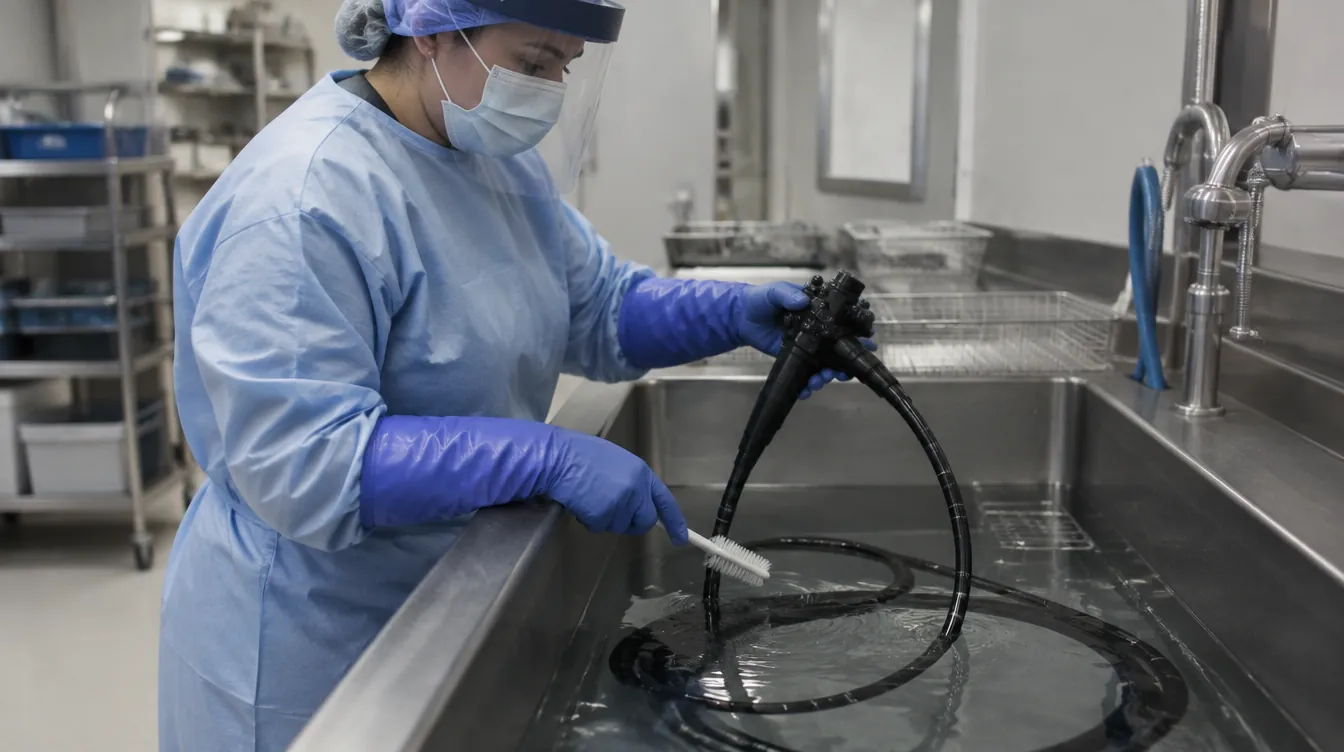
Endoscope cleaning deserves its own attention before high-level disinfection begins. For students, the challenge is understanding why the cleaning stage matters. For department leaders, it is making sure people have the information, supplies, training, and working conditions to carry out the approved process consistently.
The CDC states that cleaning is necessary before manual or automated endoscope disinfection. Its recommendations also address leak testing, appropriate cleaning accessories, compatibility, and following equipment instructions. CDC: Recommendations for Disinfection and Sterilization.
This article examines the questions that make training and process review more useful. It does not provide a universal sequence, chemical selection, dilution, temperature, or contact time. Those details belong to the current instructions for the actual device and equipment.
Why cleaning remains an industry concern
At HSPA's 2026 conference, a study presented by Mary Ann Drosnock compared cleaning approaches while also examining workload and implementation. In an Infection Control Today interview, Drosnock discussed fatigue, workspace, and the practical conditions affecting the people performing the work. It was a laboratory comparison with artificial soil, not proof that one method will produce better patient outcomes in every department.
The useful lesson for a training conversation is broader than a product choice: ask whether the environment makes the required work practical. A procedure can be clearly written while the supplies, layout, or interruptions make it difficult to follow.
That is a question leaders can investigate. It should not become another reason to tell technicians to work harder without examining the conditions around them.
Look at the whole path into the cleaning area
For a process review, start before the endoscope arrives at the workstation. Ask who knows when the procedure finished, who performed the required point-of-use activities, and how relevant information reaches the receiving team.
The aim is to understand ownership. If a responsibility sits between departments, both sides may assume the other has completed it. Draw the actual handoff and put a role next to each decision.
Use neutral questions: Where does the information come from? Where is it documented? What happens when it is missing? What is the approved escalation route?
Avoid filling gaps with assumptions based on how an item looks. Your facility's process should explain how staff respond when the processing history or timing is uncertain. A useful review reveals those questions before a busy shift makes them urgent.
Make device identification the beginning of instruction
A training session should establish exactly which device and accessories are being discussed. Similar-looking items can encourage an educator to skip over identification and move straight to a demonstration.
Ask a learner to show how they identify the model and retrieve its current instructions. That exercise reveals whether the information system is usable, not just whether the learner remembers a name.
Then ask what happens if the device cannot be matched confidently to the available instructions. The response should follow the facility's approved escalation process. A learner should not have to invent a solution in order to keep the demonstration moving.
Consider adding document retrieval to practice sessions. It is a skill worth rehearsing because it connects knowledge to the place where the work happens.
Teach what each instruction is trying to accomplish
An educator can demonstrate a task and also ask the learner to explain its purpose. Those are different checks.
Someone may copy a movement accurately without understanding the condition it depends on. Another learner may explain the purpose well but need more supervised practice with the equipment. Both forms of feedback are useful.
Try organizing a training discussion around four questions:
- What information do you need before beginning this part of the process?
- Which current instruction governs the task?
- What would make you pause and ask for help?
- How does the next person know the item's status?
Use the answers to guide teaching. Do not treat them as a substitute for direct observation or the facility's competency process. A strong explanation and demonstrated performance support each other.
Check supplies at the point where they are needed
During a walkthrough, ask staff to identify the supplies required by the approved instructions and show where those supplies are kept. Record any gap as a system issue that needs an owner.
Useful observations include a required item that is difficult to locate, an unclear stock label, or a replenishment process that depends on one person's memory. None of these observations establishes a clinical outcome, but each gives a leader a concrete problem to investigate.
Be careful with the proposed fix. Replacing an unavailable item with something that looks similar is not the same as confirming suitability. Have the responsible team resolve compatibility and purchasing questions.
A practical follow-up might be changing an approved storage location or clarifying who checks stock. The goal is to make the right materials reliably available without changing validated processing requirements.
Ask about interruptions without blaming the person
Interruptions can come from phones, questions, missing supplies, equipment concerns, or competing assignments. A technician who is interrupted is often responding to a real department need.
For one observation period, note what interrupts the task and who could address the source. Do not use the exercise to publish a ranking of distracted employees. Look for patterns in the work.
For example, repeated status calls may suggest that another department lacks a reliable way to see progress. Repeated trips for supplies may suggest a layout or replenishment problem. Questions about the same instruction may indicate a document-access issue.
Bring staff into the discussion of possible changes. Ask which interruption is most difficult to manage and what would make it easier to complete the required work. Test an approved operational change and check whether it actually helps.
Distinguish a cleaning check from a broad safety claim
A department may use inspection and cleaning-verification tools as part of its approved process. The important educational question is what a particular result means, including what it cannot establish.
Ask the educator to identify the tool, its intended use, the applicable instructions, and the response to an unacceptable result. Do not assume different tests measure the same thing or that one acceptable result proves the entire process was correct.
In a hypothetical discussion, a trainee sees a result described only as “passed.” Ask what was measured, where the sample came from, and which acceptance criteria apply. If those facts are absent, the word “passed” does not provide enough context for learning.
This habit also improves documentation. Specific records are easier to interpret than reassuring labels whose meaning changes between people.
A sample observation worksheet
The following is an original discussion tool for an educator or quality team to adapt. It is not a competency form or a regulatory checklist.
| Area to observe | Question | What to record |
|---|---|---|
| Information | Can staff retrieve the correct current instructions? | Access issue and responsible owner |
| Handoff | Is required information available on arrival? | Missing field or unclear responsibility |
| Supplies | Are approved required items available? | Specific supply issue, without substitutions |
| Workflow | What interrupts completion of the task? | Source of interruption and frequency observed |
| Escalation | Do staff know whom to contact? | Unclear role or unavailable support |
| Follow-through | Was the identified issue resolved? | Owner, action, and review date |
Keep the scope small. Reviewing one work area carefully can reveal more than completing a long checklist with no time for discussion.
A hypothetical example: the missing accessory question
Imagine a team preparing for a training session. The current instructions refer to an accessory, but the educator cannot find a matching item in the supply area. A colleague points to something that appears similar.
The useful next step is to identify the uncertainty and have the appropriate person resolve it before the task proceeds. The learning opportunity is not choosing between two unfamiliar objects by appearance.
After the immediate issue is handled, review why the mismatch was possible. Was the stock description unclear? Did purchasing change a product? Was the instruction recently revised? Was the required item stored somewhere staff did not know about?
The team can then assign a specific correction. “Be more careful” does not repair an unclear purchasing description. A verified item record and a clear replenishment process might address the actual problem.
This example is illustrative; it does not describe an ATS client or a reported patient event.
How to review a proposed new cleaning product
Industry publications can introduce useful questions. A July 2026 OR Today article on endoscope cleaning fluids discusses cleaning across the device workflow. Its author works in product development at a cleaning-product company, so readers should recognize that commercial perspective while checking technical decisions against primary instructions.
For a local product review, ask what problem you are solving and which devices would be affected. Identify who will compare instructions, evaluate equipment compatibility, review staff safety information, and coordinate training.
Include the operational details in the discussion: storage, supply continuity, labeling, staff access to instructions, and how the change will reach every shift. A purchasing decision becomes a workflow change once people must use the product.
Avoid treating a vendor presentation as completed competency documentation. The facility still needs its own process for evaluating whether staff can carry out the assigned work.
Make feedback useful to the next shift
When an issue is found, record enough detail for another person to understand it without retelling the whole story. Identify the affected device or process through the approved system, the concern, the current status, and the responsible contact.
Keep patient information inside authorized systems. A personal group chat or a photo on a private phone is not an appropriate shortcut for maintaining processing records.
Ask the receiving person to confirm the action that remains open. A note saying “manager aware” may leave everyone uncertain about what happens next. A clear owner and next review point make follow-through visible.
For broader communication skills, see building a quality culture in sterile processing. A department's response to a question influences whether people raise the next one.
What CER learners can take from this topic
Cleaning is a useful subject for practicing cause-and-effect reasoning. Instead of memorizing a disconnected list, connect the device's design, the applicable instruction, the work environment, and the information needed by the next stage.
Write down one question in each category after a study session. Which concept is unclear? Which device feature do you need help understanding? Which workflow responsibility needs explanation? Which record would show what happened?
Bring those questions to a qualified educator. The goal is to become more precise about what you understand and what still needs supervised instruction. Personal study should support the facility's training process.
Before your next equipment demonstration
Prepare one page with the device identity, the documents to review, and the questions you want the demonstrator to answer. Ask who will explain the system's limitations and what training remains the facility's responsibility afterward.
Include a staff member who will use the equipment during routine work. Ask that person to describe supply access, workspace, and the questions that arise on a busy shift. Capture unanswered questions with an owner rather than allowing them to disappear when the demonstration ends.
This preparation makes the session easier to evaluate. You leave knowing what was demonstrated, what was only discussed, and what still requires a reviewed answer before implementation.
Frequently asked questions
Does an automated reprocessor remove the need to understand cleaning?
No. Learn the validated workflow for the exact device and system, including any required preparation and manual tasks. Automation does not make device-specific instruction unnecessary.
Is a visual check enough to answer every cleaning question?
No single observation answers every question about a complex device. Learn the inspection and verification methods required by your facility and the applicable instructions, including how unacceptable results are handled.
Can I use an online checklist at the workstation?
Use approved, current workplace documents. An online article can help you prepare questions, but a local job aid needs review and control before being used to direct processing work.
What should a manager improve first?
Start with an observed obstacle to completing the approved process. Assign an owner, agree on a correction, and check whether staff can perform the work more reliably afterward. Do not assume every problem requires a new machine.
Keep learning the reasons behind the work
Understanding cleaning means understanding the decisions around it: identifying the device, finding instructions, recognizing a missing requirement, and communicating uncertainty clearly.
If endoscope reprocessing is part of your professional development plan, join the free ATS CER class waitlist. The upcoming class has no announced price, date, or format yet. ATS is an independent training provider and is not affiliated with HSPA.