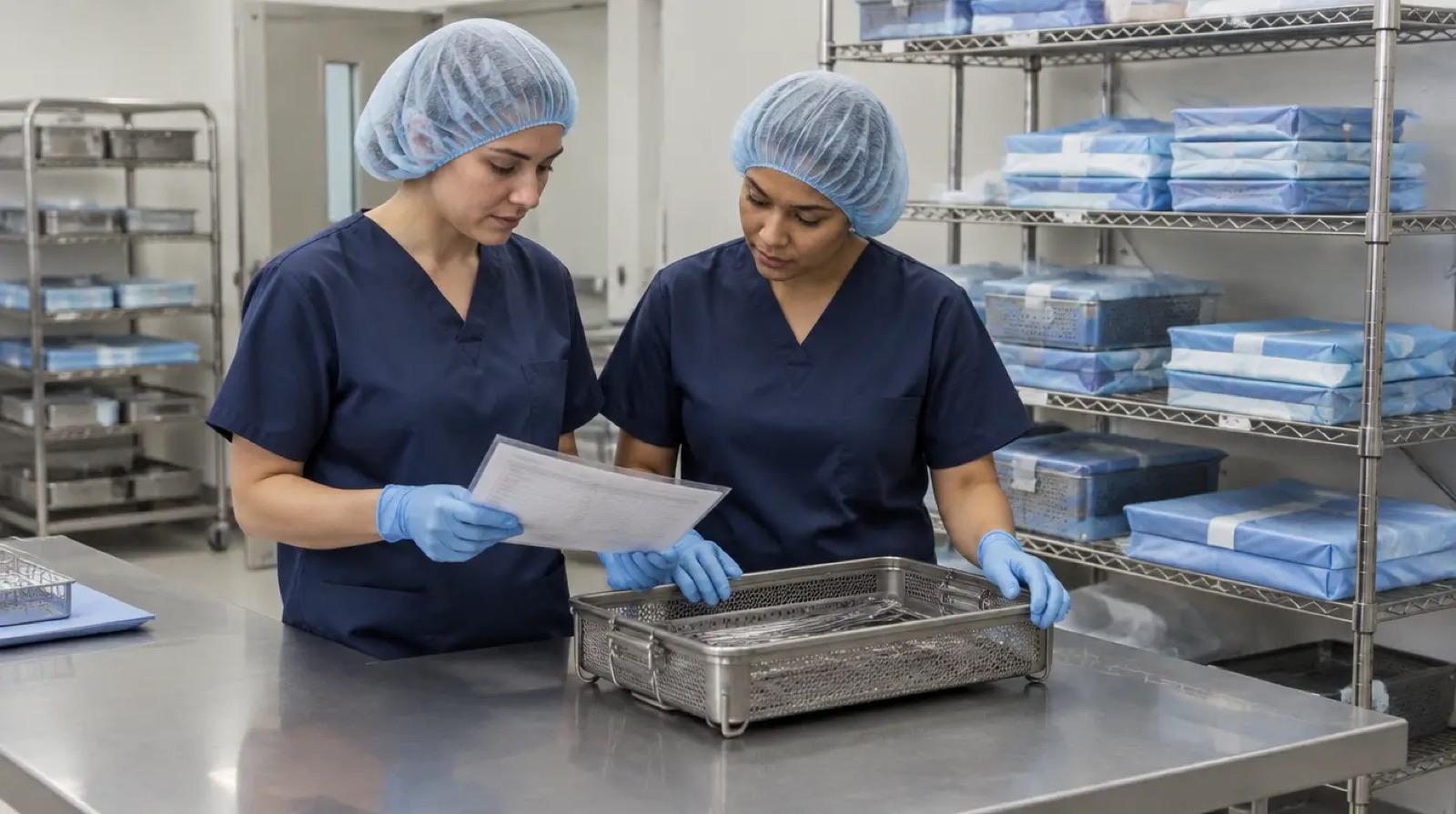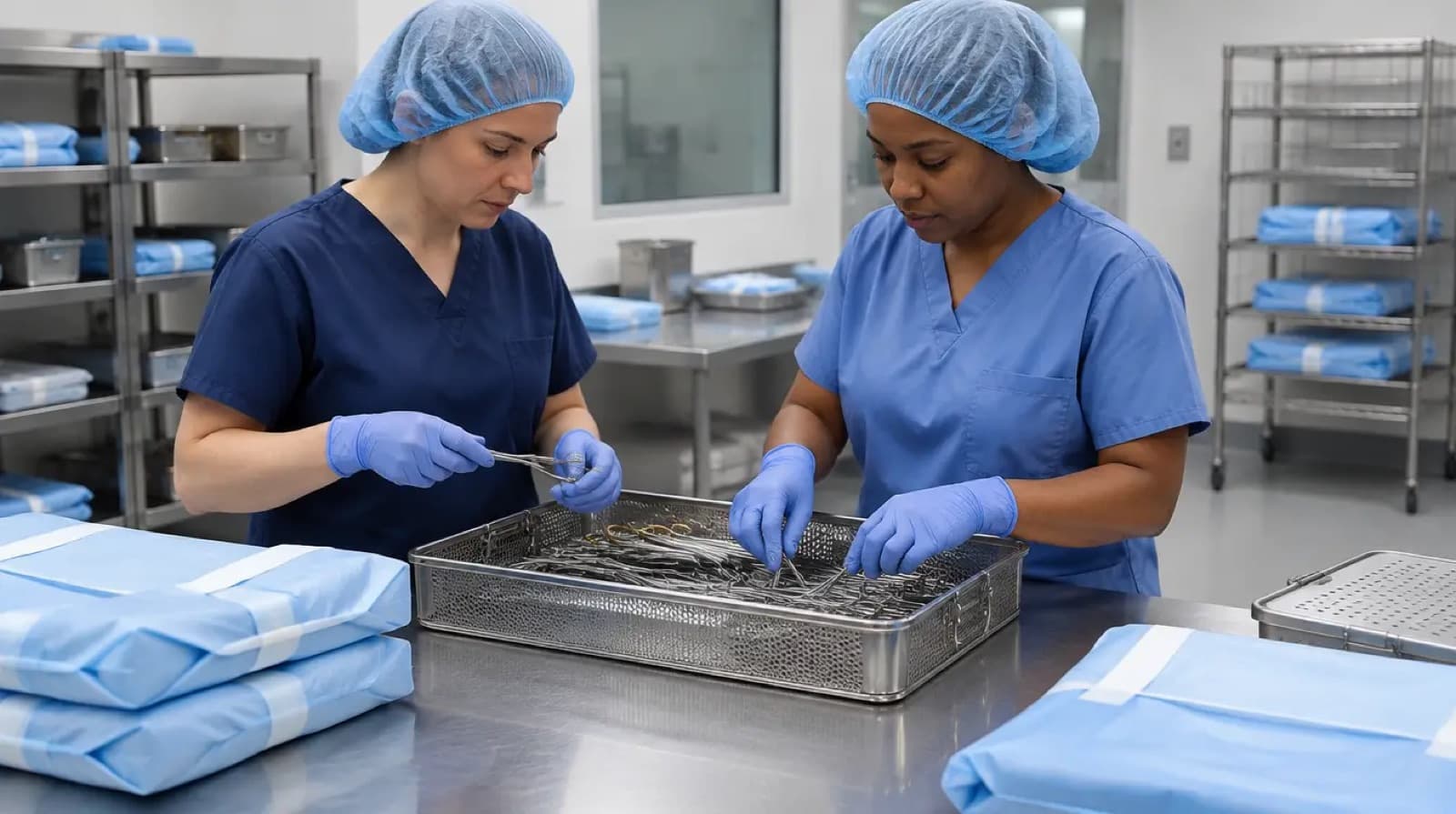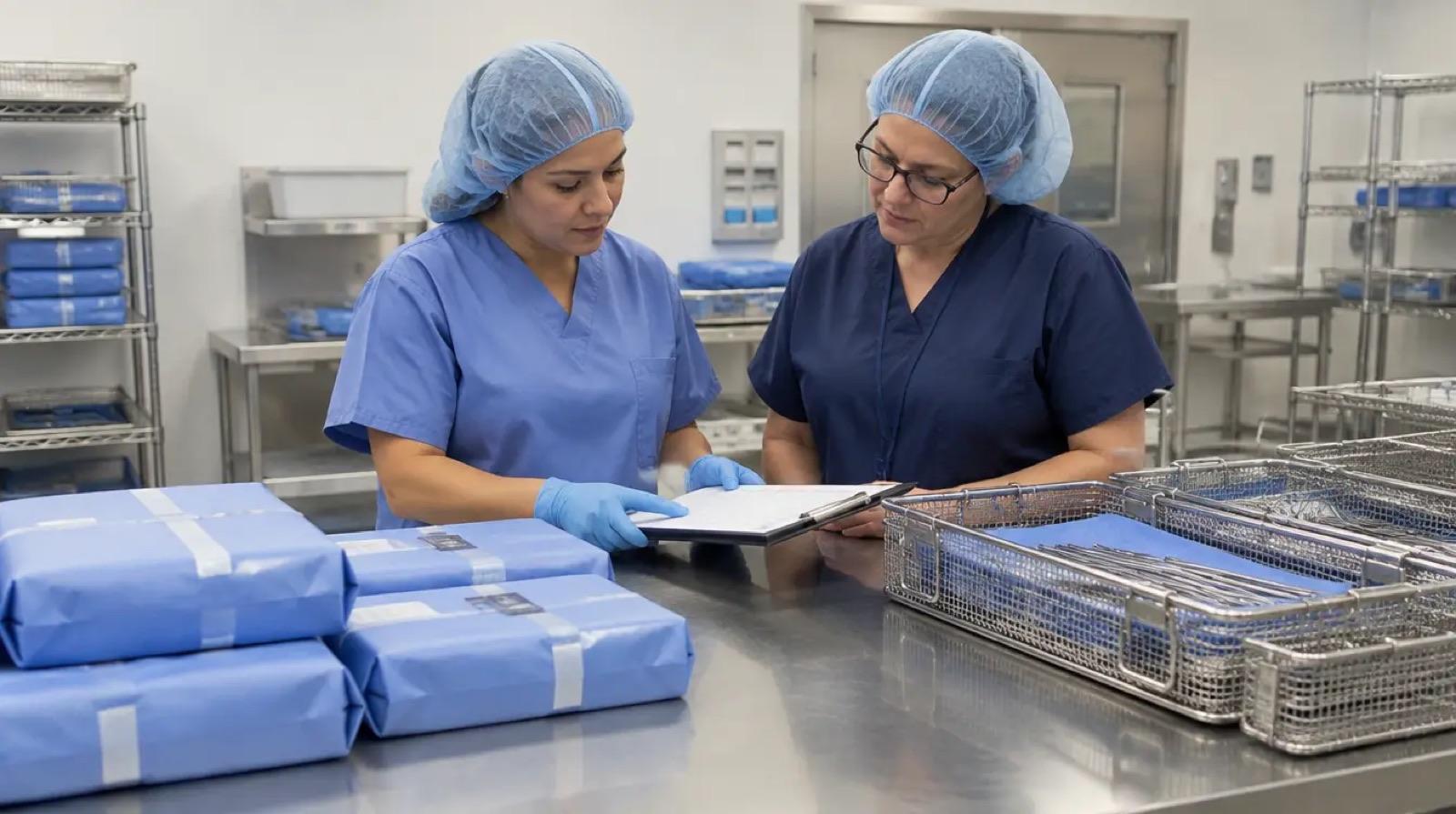
A tray can finish a steam sterilization cycle and still be unacceptable for use because its packaging or contents are wet. When that happens, the department needs two things: a controlled response to the affected items and a useful investigation of the moisture. Simply running the tray again does not explain why the problem occurred.
For a new technician, the hardest moment may be speaking up when the set is urgently needed. For an experienced team, the harder challenge may be recognizing that a familiar workaround has replaced a proper review. Both situations improve when the next action and the responsible person are clear.
This article explains how to organize a wet-pack response and investigation. It does not supply sterilizer settings, loading specifications, cooling intervals, or a universal rule for the disposition of an entire load. Current manufacturer instructions, applicable standards, and facility policy govern those decisions.
What counts as a wet-pack concern?
Moisture can be visible on the outside of a package or discovered inside when a set is opened. Record where and when it was found rather than assuming every report describes the same event. “Wet” is an important finding, but it is only the beginning of an investigation.
The CDC's Sterilizing Practices guidance states that wet sterile items are considered contaminated. Its summary recommendations, section 18.f, call for repacking and reprocessing when packaging integrity is compromised, including by moisture.
That means a damp pack does not become acceptable simply because the visible spot later disappears. Do not wipe it dry and release it, or rely on a satisfactory indicator result to dismiss the packaging problem. Keep the concern visible through the facility's approved process.
Start by controlling the affected items
Notify the designated lead and use the established hold process. Identify the affected set and load record, preserve the observed facts, and prevent accidental distribution while the responsible team determines the required disposition. Handle hot loads only as directed by the equipment instructions and local safety procedures.
The scope of the hold matters. Do not assume that one wet tray automatically proves every item is affected, and do not assume that adjacent items are acceptable because their outer surfaces look dry. Escalate the load assessment through the facility's policy and applicable guidance.
If the concern is reported after distribution, provide the location and tracking information through the event-response pathway. Processing leadership and the relevant clinical and infection-prevention teams should determine what further action is required. A technician should not make an independent patient-risk judgment from a photograph.
Capture the scene before memory replaces it
Once the items are controlled, preserve the evidence available within your role. Record the sterilizer and cycle identifiers, set identity, discovery location, and the person reporting the concern. Note whether moisture was observed during unloading, after cooling, in storage, or when the tray was opened.
Use exact observations. “Droplets seen inside the container during opening” is more useful than “the sterilizer failed.” The first describes evidence. The second is a diagnosis that may or may not be supported by the investigation.
If your facility permits photographs, use its approved system and protect confidential information. A useful image shows the relevant configuration or moisture location without replacing the written record. Do not disrupt safe handling or open additional sterile packs merely to create pictures for a general teaching discussion.
Why the investigation needs more than one department
STERIS's discussion of steam sterilizer load drying identifies several possible contributors to wet packs, including steam conditions, loading, and equipment problems. It recommends investigating the underlying issue rather than relying on an inherited workaround. The article is manufacturer education, not the operating manual for every sterilizer.
That distinction shapes the review. SPD can describe preparation, packaging, and the observed workflow. Equipment service personnel can assess the sterilizer within their responsibilities. Facilities staff may need to evaluate the relevant utilities. Infection prevention can help with the risk assessment and affected-item response.
No single person's first impression should become the conclusion simply because it arrived first. Put the available observations together, identify what is still unknown, and assign each technical question to someone qualified to answer it.
A practical wet-pack investigation record
The following table is an original discussion tool. Have the responsible team adapt it to local records and procedures; it is not an official standard or an authorization to change a cycle.
| Question | Useful evidence | Why it helps |
|---|---|---|
| What was wet? | Set identifier, packaging type, and exact moisture location | Separates different kinds of reports |
| When was it noticed? | Discovery stage and documented time | Establishes the sequence without guessing |
| Which process was involved? | Sterilizer, cycle, load, and linked records | Connects the finding to the correct history |
| What was in the load? | Approved load record and available configuration evidence | Gives reviewers a specific arrangement to assess |
| What changed recently? | Packaging, set configuration, equipment service, or workflow changes | Creates questions for investigation, not automatic causes |
| Who is reviewing each issue? | Named SPD, service, facilities, or clinical owner | Prevents unanswered requests from circulating |
| What remains restricted? | Affected-item and equipment status | Keeps the operational decision visible |
| How will closure be shown? | Authorized disposition and supporting follow-up | Distinguishes a completed review from a temporary fix |
A short, complete record is more valuable than a long form filled with assumptions. If a field cannot be confirmed, say so and identify who will try to resolve it. Do not reconstruct a loading pattern from what people usually do and label it as an observation of this event.
Review preparation and packaging without changing the recipe
Ask the responsible reviewer to compare the actual set and packaging configuration with the applicable instructions. Identify the materials and components used, not just the general name of the tray. A recent change may be relevant, but its timing alone does not prove causation.
Bring precise questions. Was the same approved packaging system used? Does the set record reflect what was actually assembled? Are any accessories or inserts different? Is the instruction set complete for the combination being processed?
If a mismatch is identified, follow the approved correction process. Adding a liner, changing a wrap, or rearranging components based on an informal suggestion can introduce another variable before the original problem is understood. Any proposed change needs review for the actual device, packaging system, and processing equipment.
Review loading, cycle records, and cooling as separate steps
An investigation becomes easier to follow when it preserves the sequence. Review the documented loading arrangement, the selected cycle and available cycle record, then the unloading and cooling practices against the applicable instructions. Do not collapse all of those stages into a single label such as “operator issue.”
Ask the employee to describe what happened in their own words. If the practice differs from the approved process, find out why. A missing instruction, a workspace limitation, or conflicting coaching may require a different correction from a one-time deviation.
Keep numerical settings in the controlled documentation. A blog cannot determine the correct drying time, load limit, door position, or cooling interval for the equipment and contents in front of you. If the instructions are unclear, obtain clarification through the designated manufacturer and facility contacts.
Give equipment and facilities teams an answerable request
“Please check the sterilizer” may be necessary as an initial call, but it is not a complete investigation request. Share the equipment identifier, event timing, available records, specific observations, and whether other equipment or loads have similar reports.
Ask service and facilities personnel what additional information would help them distinguish possible explanations. Their review may involve conditions that processing staff cannot evaluate safely or reliably. Do not ask an untrained technician to adjust utilities, bypass controls, or experiment with cycle settings.
Record what the specialists actually conclude. If a service visit finds no confirmed defect, that is different from proving that no equipment-related issue is possible. Likewise, a repaired component does not by itself establish that every affected item has received its required disposition.
Hypothetical example: one recurring set keeps returning wet
Imagine that a department receives several moisture reports involving the same named set. An informal explanation develops that the set is simply difficult. Staff begin planning around another processing run without documenting what differs between the reports.
In this fictional teaching example, the lead gathers the set identifiers, packaging details, load records, and discovery stages. The review reveals that two configurations share a common display name. That finding gives the team a more precise comparison to make; it does not yet explain the moisture.
The next step is to assess each actual configuration against its applicable instructions and compare the available evidence. A better identifier in the tracking system may help future reporting. The lesson is to improve the question before announcing the cause, rather than treating a recurring label as an explanation.
A cluster of reports calls for a broader view
When multiple reports occur, organize them so reviewers can see what is shared and what differs. Compare dates, equipment, set configurations, packaging systems, discovery locations, and documented changes. Use available records rather than asking staff to remember every detail after the shift ends.
A pattern helps decide where to investigate. It does not prove cause. For example, several events following maintenance justify reviewing that work, but they do not establish that the service caused the problem. The same caution applies to a new employee, a new product, or a particular shift.
Avoid turning the review into an employee scoreboard. If reporting becomes a source of embarrassment, the next person may hesitate to describe a concern accurately. The objective is a trustworthy account that supports a defensible decision about items, equipment, and follow-up.
Keep case planning separate from technical release
The operating room needs timely information when an expected set is unavailable. Use the agreed channel to identify the affected set, current status, and time of the next update. The clinical team can then review alternatives within its own responsibilities.
Do not offer a return time based only on how long a routine cycle usually takes. Reprocessing, investigation, approved alternatives, and release decisions may change availability. Giving an honest update is more useful than repeatedly moving a promise the department could not support.
An urgent request does not resolve the wet-pack finding. Keep scheduling decisions with the clinical service and technical disposition with the authorized processing team. Clear ownership allows both teams to work on the problem without converting a case deadline into permission to skip a requirement.
Close the event and the cause as distinct tasks
An affected tray may complete its required reprocessing before the underlying investigation is finished. Conversely, a suspected cause may be corrected while some affected-item records remain open. Track those tasks separately so one cannot disappear behind the other.
For event closure, identify the authorized disposition and supporting records. For the investigation, document the evidence, the conclusion or remaining uncertainty, the action taken, and who will evaluate the follow-up. If the cause remains unconfirmed, use that wording.
A new period without reports is encouraging, but its meaning depends on what work occurred and how observations were collected. Avoid claiming a permanent fix after a single uneventful load. The responsible team should choose follow-up that reflects the original concern and the applicable instructions.
Practice reporting before the next urgent request
Use a fictional event card during education. Give the learner a set identifier, a discovery stage, and an incomplete record. Ask them to explain the immediate communication, what facts they would preserve, and which questions need escalation.
The exercise should reward accurate limits. A learner who says “I cannot determine the cause from this information” and asks the right follow-up questions is demonstrating useful judgment. A confident explanation based on an assumed equipment fault is less helpful.
Then ask another learner to receive the handoff. Can they identify what is held, who owns the review, and when an update is expected? That check makes the exercise practical. It tests whether the next employee can act on the information, not just whether the first employee can recite definitions.
Keep moisture and physical damage distinct
A wet pack and a torn wrapper both raise package-integrity concerns, but the investigations should preserve their different observations. A generic “packaging failure” category can conceal whether the department is dealing with handling damage, moisture, or both.
Use the existing torn sterile wrap response checklist when physical damage is the finding. For moisture, retain the discovery stage and relevant process records so the appropriate specialists can evaluate the evidence.
You do not need a complicated new dashboard to begin. Review a small set of complete event records with the responsible team, identify the most important unanswered question, and assign it. The value comes from a question someone can resolve and a correction someone can verify.
Frequently asked questions
Can a wet sterile pack be used once it looks dry?
No. Visible drying does not undo the moisture event. Keep the item out of use and follow the approved repacking and reprocessing pathway.
Does a satisfactory indicator result override a wet-pack finding?
No. Process-monitoring results do not cancel a packaging-integrity concern. The wet item still requires the facility's approved response.
Does one wet tray mean the entire load must be discarded?
Do not make that decision from a general blog rule. Hold and escalate the concern, preserve the load information, and follow facility policy and applicable guidance for assessing the affected load and required reprocessing.
Should technicians increase drying time on their own?
No. Changes must be reviewed against the applicable device, packaging, and sterilizer instructions and authorized through the facility's process. An improvised setting can obscure the cause and introduce another problem.
Who should help investigate repeated wet packs?
Processing leadership should coordinate the review with the relevant equipment-service, facilities, infection-prevention, and clinical teams. Each should address questions within its responsibility using the actual event records.
Learn the decisions behind the task
A useful starting exercise is to trace one fictional wet-pack report from discovery to documented disposition. Explain what the technician observes, what the lead coordinates, and what the specialists need to resolve. Keep the operating instructions beside the exercise rather than replacing them with remembered settings.
Explore ATS in-person sterile processing training to build a broader foundation for these workplace decisions. Education supports your learning; independent processing responsibilities still depend on the facility's training, competency assessment, and authorization.